Post-Impressionism
Post-Impressionism spans roughly 1885–1910.
Post-Impressionism covers roughly 1885 to 1910. It is not one unified style but a loose label for painters who came directly after the Impressionists, kept their bright color, but reacted against what they saw as Impressionism’s loose structure and narrow focus on fleeting optical effects.
Why it looks the way it does
Because it was a reaction rather than a single program, its look varies more than Impressionism’s does. Georges Seurat developed Pointillism, applying paint in small dots of pure color to be blended optically by the eye. Paul Cézanne simplified natural forms into underlying geometric structure. Vincent van Gogh used thick, energetic brushwork and intense color to convey emotion rather than optical accuracy. Paul Gauguin flattened forms and used bold, symbolic color drawn from folk and non-Western art. What unites them is a move away from simply recording what the eye sees, toward using color and form more deliberately.
How to tell it apart from Impressionism
Look for more deliberate brushwork or composition, stronger outlines or geometric simplification, and color used for effect or symbolism rather than to match observed light. A late Van Gogh sky reads as more constructed and intentional than a Monet haystack painted quickly outdoors.
Key names
Vincent van Gogh, Paul Cézanne, Paul Gauguin, Georges Seurat, and Henri de Toulouse-Lautrec, each pursuing a distinct personal direction rather than a shared manifesto.
Updated: 2026-07-09
Artworks from this movement
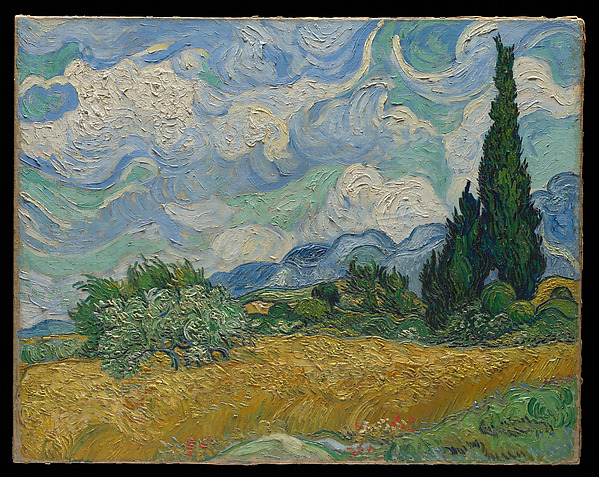 Wheat Field with Cypresses (1889)
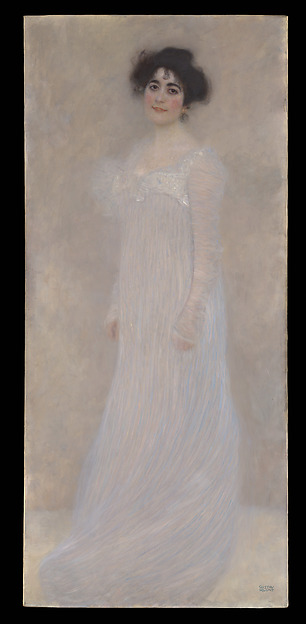 Serena Pulitzer Lederer (1867–1943) (1899)
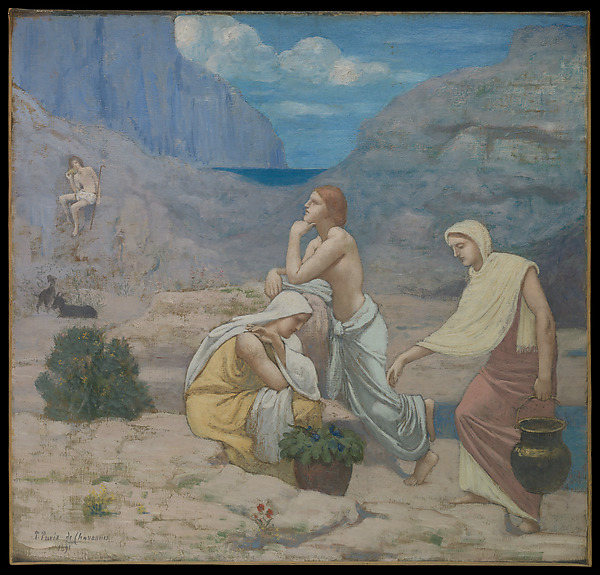 The Shepherd's Song (1891)
 The Englishman (William Tom Warrener, 1861–1934) at the Moulin Rouge (1892)
 Still Life with Teapot and Fruit (1896)
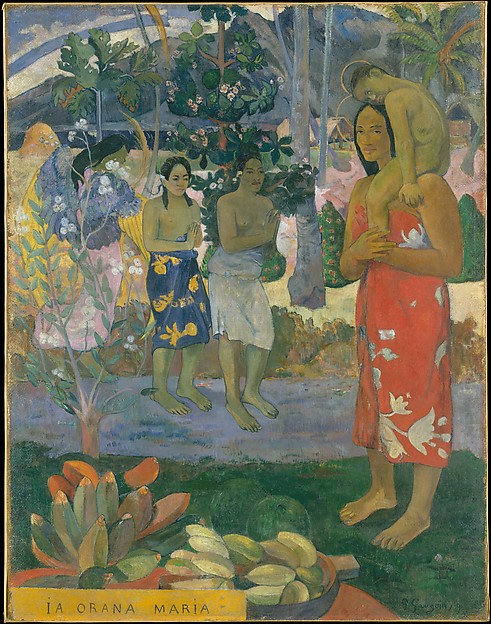 Ia Orana Maria (Hail Mary) (1891)
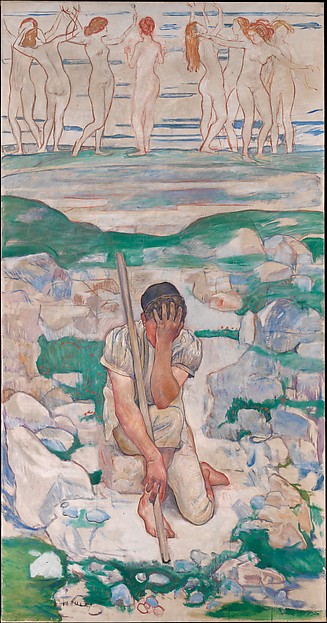 The Dream of the Shepherd (Der Traum des Hirten) (1896)